Japanese Names That Mean Moon 150+ Beautiful Names with Kanji and Meanings
Japan has one of the most poetic relationships with the moon in the entire world. Every autumn, families gather for Tsukimi, the centuries-old tradition of moon viewing, eating rice cakes and admiring the harvest moon together. The moon appears in Japan’s oldest poetry, its most celebrated stories, and its most beloved anime and films. It represents beauty, mystery, the passage of time, and the quiet grace of the natural world.
Whether you are looking for a Japanese girl name meaning moon, a strong Japanese boy name connected to the lunar world, a Japanese last name that means moon, or something connected to the blood moon, this guide has everything you need. We have compiled 150 Japanese names that mean moon from authentic Japanese naming tradition, complete with kanji, meanings, and pronunciations.
What Does Moon Mean in Japanese
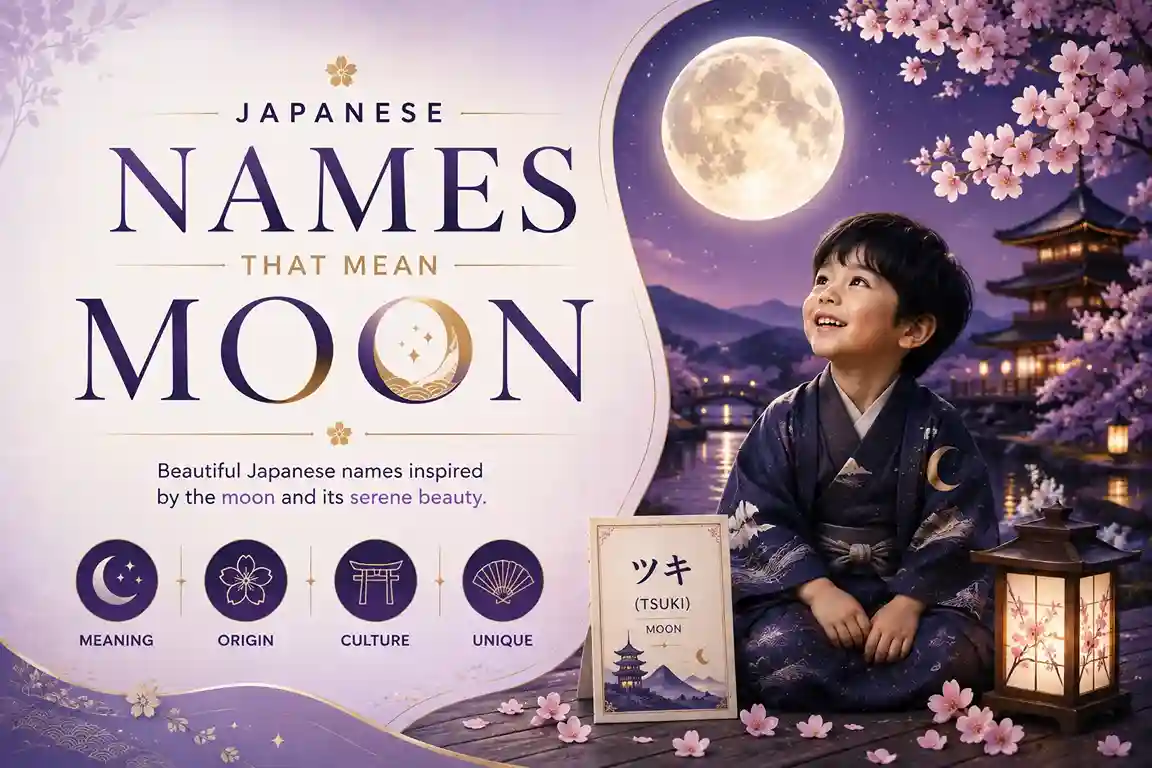
Tsuki (月) is the most common Japanese word for moon. It appears in the majority of Japanese names meaning moon and is one of the most recognizable kanji characters in the language.
Getsu or gatsu (月) is the same kanji but read in the Chinese-influenced pronunciation, used in many compound names. Mitsuki, Yuzuki, Tsukiko, and Hazuki are all examples of how the moon kanji (月) combines with other characters to create names full of poetic meaning.
150 Japanese Names That Mean Moon
All names below come from authentic Japanese kanji combinations and verified naming traditions.
| Name | Meaning | Kanji | Origin | Gender | Pronunciation | Popularity |
|---|---|---|---|---|---|---|
| Tsukinaga | Eternal moon | 月永 | Japanese | Unisex | — | Rare |
| Sorayn | Pale glow of the moon | — | Japanese | Unisex | so-ra-y-n | Uncommon |
| Jonetsuon | Pale glow of the moon | — | Japanese | Female | jo-ne-tsu-o-n | Rare |
| Yukigetsu | Snow moon | 雪月 | Japanese | Female | — | Rare |
| Tsukisuzu | Moon bell | 月鈴 | Japanese | Female | — | Rare |
| Tsuki | Moon; month | 月 | Japanese | Female | TSOO-kee | Rare |
| Hototsuki | Lonely moon | 独月 | Japanese | Female | — | Rare |
| Delar | Pale glow of the moon | — | Japanese | Unisex | de-la-r | Uncommon |
| Kurezuki | Twilight moon | 暮月 | Japanese | Female | — | Rare |
| Kazuar | Pale glow of the moon | — | Japanese | Unisex | ka-zu-a-r | Uncommon |
| Tsukihanae | Moon blossom grace | 月花恵 | Japanese | Female | — | Rare |
| Tsukihama | Moon shore | 月浜 | Japanese | Unisex | — | Rare |
| Akigetsu | Autumn moon | 秋月 | Japanese | Male | — | Rare |
| Tsukihime | Moon princess | 月姫 | Japanese | Female | — | Rare |
| Katsuar | Pale glow of the moon | — | Japanese | Male | ka-tsu-a-r | Uncommon |
| Tsukimoto | Origin of the moon | 月本 | Japanese | Male | — | Rare |
| Kaguya | Radiant moon princess | 輝夜 | Japanese | Female | kah-GOO-yah | Uncommon |
| Naoa | Pale glow of the moon | — | Japanese | Unisex | na-oa | Uncommon |
| Tomogetsu | Companion of the moon | 友月 | Japanese | Male | — | Rare |
| Sylilia | Pale glow of the moon | — | Japanese | Male | sy-li-li-a | Rare |
| Tsukimori | Forest of the moon | 月森 | Japanese | Unisex | — | Rare |
| Kanagetsu | Golden moon | 金月 | Japanese | Female | — | Rare |
| Fumigetsu | Scholarly moon | 文月 | Japanese | Female | — | Rare |
| Sayaka | Clear moonlight | 清香月 | Japanese | Female | — | Rare |
| Tsukimiya | Shrine of the moon | 月宮 | Japanese | Female | — | Rare |
| Tsukishiro | White moon | 月白 | Japanese | Female | — | Rare |
| Amagetsu | Heaven's moon | 天月 | Japanese | Female | — | Rare |
| Enzuki | Circle moon | 円月 | Japanese | Female | — | Rare |
| Tsukihana | Moon flower | 月花 | Japanese | Female | tsoo-kee-HAH-nah | Rare |
| Raigetsu | Thunder moon | 雷月 | Japanese | Female | — | Rare |
| Senko | Celestial moon | 仙月 | Japanese | Female | — | Rare |
| Kozuki | Heart moon | 心月 | Japanese | Female | — | Rare |
| Fenia | Pale glow of the moon | — | Japanese | Male | fe-ni-a | Rare |
| Shirogetsu | Pale moon | 白月 | Japanese | Female | — | Rare |
| Sorazuki | Sky moon | 空月 | Japanese | Female | — | Rare |
| Tsukihoshi | Moon and star | 月星 | Japanese | Female | — | Rare |
| Tsukitani | Moon valley | 月谷 | Japanese | Unisex | — | Rare |
| Ugetsu | Rain and moon | 雨月 | Japanese | Female | — | Rare |
| Kaitoel | Pale glow of the moon | — | Japanese | Male | ka-i-to-e-l | Uncommon |
| Hinazuki | Sunshine moon | 陽月 | Japanese | Female | — | Rare |
| Shizuki | Quiet moon | 静月 | Japanese | Female | — | Rare |
| Tsukikaze | Moon wind | 月風 | Japanese | Unisex | — | Rare |
| Mangetsu | Full moon | 満月 | Japanese | Male | — | Rare |
| Getsuya | Night of the moon | 月夜 | Japanese | Male | — | Rare |
| Kanatsuki | Golden moon | 金月 | Japanese | Female | — | Rare |
| Tsukiyori | Moon's blessing | 月頼 | Japanese | Female | — | Rare |
| Kyogetsu | Mirror moon | 鏡月 | Japanese | Female | — | Rare |
| Nobugetsu | Faithful moon | 信月 | Japanese | Male | — | Rare |
| Harutsuki | Spring moon | 春月 | Japanese | Female | — | Rare |
| Rinolmir | Pale glow of the moon | — | Japanese | Female | ri-no-l-mi-r | Rare |
| Mikazuki | Crescent moon | 三日月 | Japanese | Female | — | Rare |
| Ryoma | Dragon moon | 龍月 | Japanese | Male | — | Uncommon |
| Aizuki | Loving moon | 愛月 | Japanese | Female | — | Rare |
| Mitsutsuki | Shining moon | 光月 | Japanese | Female | — | Rare |
| Kalalorn | Pale glow of the moon | — | Japanese | Male | ka-la-lo-r-n | Uncommon |
| Tsukina | Moon greens | 月菜 | Japanese | Female | — | Rare |
| Tsukikado | Moon gate | 月門 | Japanese | Unisex | — | Rare |
| Nanatsuki | Seventh moon | 七月 | Japanese | Female | — | Rare |
| Tsukisato | Moon village | 月里 | Japanese | Unisex | — | Rare |
| Gekkou | Moonlight | 月光 | Japanese | Male | — | Rare |
| Rinesar | Pale glow of the moon | — | Japanese | Unisex | ri-ne-sa-r | Uncommon |
| Kalaldra | Pale glow of the moon | — | Japanese | Female | ka-la-l-d-ra | Rare |
| Amatsukiyo | Celestial moonlit night | 天月夜 | Japanese | Female | — | Rare |
| Halilia | Pale glow of the moon | — | Japanese | Male | ha-li-li-a | Rare |
| Hikariiel | Pale glow of the moon | — | Japanese | Unisex | hi-ka-ri-ie-l | Uncommon |
| Yumitsuki | Dream moonlight | 夢月光 | Japanese | Female | — | Rare |
| Tsukizawa | Moon marsh | 月沢 | Japanese | Unisex | — | Rare |
| Arizuki | Moon of peace | 有月 | Japanese | Female | — | Rare |
| Akitsuki | Autumn moon | 秋月 | Japanese | Female | — | Rare |
| Hisagetsu | Long-lasting moon | 久月 | Japanese | Female | — | Rare |
| Tsukiyomi | Moon god | 月読 | Japanese | Male | — | Rare |
| Tsukimaru | Moon circle | 月丸 | Japanese | Male | — | Rare |
| Tsukihiko | Moon prince | 月彦 | Japanese | Male | — | Rare |
| Jougetsu | Superior moon | 上月 | Japanese | Male | — | Rare |
| Mitsuki | Beautiful moon | 美月 | Japanese | Female | mit-SOO-kee | Common |
| Chigetsu | Wisdom moon | 智月 | Japanese | Male | — | Rare |
| Shinagetsu | True moon | 真月 | Japanese | Female | — | Rare |
| Hazuki | Leaf moon | 葉月 | Japanese | Female | hah-ZOO-kee | Uncommon |
| Rengetsu | Lotus moon | 蓮月 | Japanese | Female | — | Rare |
| Tsukine | Sound of the moon | 月音 | Japanese | Female | — | Rare |
| Aratsuki | New moon rising | 新月 | Japanese | Female | — | Rare |
| Tsukino | Of the moon | 月乃 | Japanese | Female | tsoo-KEE-noh | Rare |
| Yozuki | Night moon | 夜月 | Japanese | Female | — | Rare |
| Sogetsu | Twin moon | 双月 | Japanese | Male | — | Rare |
| Rikigetsu | Strong moon | 力月 | Japanese | Male | — | Rare |
| Ryuuia | Pale glow of the moon | — | Japanese | Unisex | ryu-ui-a | Rare |
| Tsukihara | Moon meadow | 月原 | Japanese | Unisex | — | Rare |
| Runa | Moon beauty | 琉月 | Japanese | Female | ROO-nah | Uncommon |
| Tsukiwaka | Young moon | 月若 | Japanese | Female | — | Rare |
| Voralyx | Pale glow of the moon | — | Japanese | Male | vo-ra-ly-x | Rare |
| Shingetsu | New moon | 新月 | Japanese | Male | — | Rare |
| Elulion | Pale glow of the moon | — | Japanese | Female | e-lu-li-o-n | Uncommon |
| Fuyuzuki | Winter moon | 冬月 | Japanese | Female | — | Rare |
| Kagetoki | Shadow of the moon | 影月 | Japanese | Male | — | Rare |
| Kuretsuki | Dusk moon | 暮月 | Japanese | Female | — | Rare |
| Mayuzuki | Gentle night moon | 真優月 | Japanese | Female | — | Rare |
| Ayatsuki | Twinkling moon | 彩月 | Japanese | Female | — | Rare |
| Yuzuki | Binding moon | 結月 | Japanese | Female | yoo-ZOO-kee | Uncommon |
| Oborozuki | Hazy moon | 朧月 | Japanese | Female | — | Rare |
| Rikuix | Pale glow of the moon | — | Japanese | Male | ri-ku-i-x | Uncommon |
| Kirizuki | Misty moon | 霧月 | Japanese | Female | — | Rare |
| Aeranion | Pale glow of the moon | — | Japanese | Unisex | ae-ra-ni-o-n | Uncommon |
| Getsurou | Moon path | 月路 | Japanese | Male | — | Rare |
| Rengezuki | Lotus moon | 蓮月 | Japanese | Female | — | Rare |
| Tsukasa | Moon controller | 月佐 | Japanese | Male | — | Rare |
| Tsukihashi | Moon bridge | 月橋 | Japanese | Unisex | — | Rare |
| Tsukio | Moon man | 月雄 | Japanese | Male | — | Rare |
| Tsukika | Fragrance of the moon | 月香 | Japanese | Female | — | Rare |
| Mizuki | Beautiful moon | 美月 | Japanese | Female | mee-ZOO-kee | Common |
| Rinar | Pale glow of the moon | — | Japanese | Female | ri-na-r | Uncommon |
| Tsukisora | Moon sky | 月空 | Japanese | Female | — | Rare |
| Ritsuki | Moon rhythm | 律月 | Japanese | Female | — | Rare |
| Kaigetsu | Sea moon | 海月 | Japanese | Male | — | Rare |
| Yumetsuki | Dream moon | 夢月 | Japanese | Female | — | Rare |
| Asatsuki | Morning moon | 朝月 | Japanese | Female | — | Rare |
| Tsukiyama | Moon mountain | 月山 | Japanese | Unisex | — | Rare |
| Getsumei | Bright moon | 月明 | Japanese | Female | get-SOO-may | Rare |
| Hoshizuki | Star moon | 星月 | Japanese | Female | — | Rare |
| Tsukikawa | Moon river | 月川 | Japanese | Unisex | — | Rare |
| Elolora | Pale glow of the moon | — | Japanese | Male | e-lo-lo-ra | Uncommon |
| Reigetsu | Spiritual moon | 霊月 | Japanese | Male | — | Rare |
| Tsukigane | Moon bell | 月鐘 | Japanese | Unisex | — | Rare |
| Tsukiharu | Spring moon | 月春 | Japanese | Female | — | Rare |
| Reikazuki | Spirit light moon | 霊光月 | Japanese | Female | — | Rare |
| Ryuon | Pale glow of the moon | — | Japanese | Male | ryu-o-n | Uncommon |
| Tsukiryo | Soul of the moon | 月霊 | Japanese | Female | — | Rare |
| Kizuki | Hopeful moon | 希月 | Japanese | Female | — | Rare |
| Tsukimura | Moon village | 月村 | Japanese | Unisex | — | Rare |
| Tsukifune | Moon ship | 月舟 | Japanese | Unisex | — | Rare |
| Kogetsu | Small moon | 小月 | Japanese | Male | — | Rare |
| Tsukiyume | Moon dream | 月夢 | Japanese | Female | — | Rare |
| Kaito | Ocean moon | 海月 | Japanese | Male | — | Common |
| Himezuki | Princess moon | 姫月 | Japanese | Female | — | Rare |
| Kagetsu | Fragrant moon | 香月 | Japanese | Female | — | Rare |
| Akatsuki | Dawn moon glow | 暁 | Japanese | Female | ah-KAH-tsoo-kee | Uncommon |
| Tsukizaki | Moon cape | 月崎 | Japanese | Unisex | — | Rare |
| Tatsugetsu | Dragon moon | 龍月 | Japanese | Male | — | Rare |
| Satsuki | Blooming moon | 咲月 | Japanese | Female | sat-SOO-kee | Uncommon |
| Tsukuyomi | Moon reader | — | Japanese | Female | tsu-ku-yo-mi | Rare |
| Yotsuki | Night moon | 夜月 | Japanese | Female | — | Rare |
| Fumizuki | Letter moon (July) | 文月 | Japanese | Female | — | Rare |
| Tsukiyo | Moonlit night | 月夜 | Japanese | Female | tsoo-KEE-yoh | Rare |
| Tsukiko | Child of the moon | 月子 | Japanese | Female | — | Rare |
| Eluleon | Pale glow of the moon | — | Japanese | Unisex | e-lu-le-o-n | Uncommon |
| Hanazuki | Flower moon | 花月 | Japanese | Female | — | Rare |
| Rento | Lotus moon | 蓮月 | Japanese | Male | — | Rare |
| Tsukishima | Moon island | 月島 | Japanese | Unisex | — | Rare |
| Tsukiro | Path of the moon | 月路 | Japanese | Female | — | Rare |
| Tsukimi | Moon viewing | 月見 | Japanese | Female | tsoo-KEE-mee | Rare |
| Reito | Cool moon | — | Japanese | Unisex | RAY-toh | Uncommon |
| Hoshiel | Pale glow of the moon | — | Japanese | Female | ho-shi-e-l | Uncommon |
| Tsukisai | Festival of the moon | 月祭 | Japanese | Female | — | Rare |
| Umigetsu | Sea moon | 海月 | Japanese | Female | — | Rare |
| Tokigetsu | Timeless moon | 時月 | Japanese | Female | — | Rare |
| Sukiar | Pale glow of the moon | — | Japanese | Female | su-ki-a-r | Uncommon |
| Tsukihina | Gentle moonlight | 月陽奈 | Japanese | Female | — | Rare |
| Tsukida | Moon field | 月田 | Japanese | Unisex | — | Rare |
| Minatsuki | Harbor moon | 湊月 | Japanese | Female | — | Rare |
| Amatsuki | Heavenly moon | 天月 | Japanese | Female | — | Rare |
| Tsukirei | Beautiful moon spirit | 月麗 | Japanese | Female | — | Rare |
| Galmir | Pale glow of the moon | — | Japanese | Female | ga-l-mi-r | Uncommon |
| Tsukiya | Moonlit night | 月夜 | Japanese | Female | — | Rare |
| Rinonith | Pale glow of the moon | — | Japanese | Unisex | ri-no-ni-t-h | Uncommon |
| Rukia | Moon spirit | 瑠姫亜 | Japanese | Female | ROO-kee-ah | Uncommon |
| Growthyn | Pale glow of the moon | — | Japanese | Unisex | g-ro-w-t-hy-n | Rare |
| Hanain | Pale glow of the moon | — | Japanese | Female | ha-na-i-n | Uncommon |
Names That Mean Moon in Japanese: Detailed Meanings
Tsukiko
Meaning: Child of the moon
Origin: Japanese
Pronunciation: tsoo-kee-koh
Kanji: 月子
Culture: One of the most classic Japanese girl names meaning moon. The kanji 月 (moon) combined with 子 (child) creates a name deeply rooted in traditional Japanese naming conventions where the suffix ko (child) was extremely popular for girls throughout the twentieth century.
Symbolism: Represents a child born under the light and protection of the moon, blessed with its calmness and beauty.
Why parents choose this name: Tsukiko is familiar yet poetic. It sounds traditionally Japanese while carrying the celestial weight of the moon in every syllable.
Famous Namesake: Tsukiko Amano, a well-known Japanese singer-songwriter celebrated for her dreamy, atmospheric music.
Mitsuki
Meaning: Beautiful moon
Origin: Japanese
Pronunciation: mit-SOO-ke
Kanji: 美月
Culture: Mitsuki combines 美 (beautiful, excellent) with 月 (moon). It is consistently one of the most popular Japanese girl names meaning moon and regularly appears in Japan’s annual top name rankings.
Symbolism: Represents the visual beauty of the moon, its elegance and the sense of wonder it creates when reflected on still water or seen rising over a mountain.
Why parents choose this name: Mitsuki works beautifully for both boys and girls, sounds soft and musical, and carries a meaning that every culture can immediately appreciate.
Famous Namesake: Mitsuki, a popular Japanese experimental pop singer known internationally for her album Nothing Matters.
Kaguya
Meaning: Radiant moon princess
Origin: Japanese
Pronunciation: kah-GOO-yah
Kanji: 輝夜
Culture: Kaguya-hime (Princess Kaguya) is the heroine of The Tale of the Bamboo Cutter, Japan’s oldest known narrative dating back over a thousand years. She was a moon princess discovered inside a glowing bamboo stalk, raised on earth, and eventually returned to the moon.
Symbolism: Represents the moon as a place of origin, purity, and divine mystery. Kaguya embodies the idea that the moon is not just a light in the sky but a home for beings of extraordinary beauty.
Why parents choose this name: Parents drawn to mythology, folklore, and names with deep roots will find nothing more powerful in the Japanese moon name tradition.
Famous Namesake: Kaguya-hime from The Tale of the Bamboo Cutter. JAXA’s KAGUYA spacecraft, Japan’s most ambitious lunar orbiter mission.
Mikazuki
Meaning: Crescent moon
Origin: Japanese
Pronunciation: mee-kah-ZOO-kee
Kanji: 三日月
Culture: Mikazuki literally means the moon on its third day, which in Japanese tradition refers to the delicate crescent moon that appears shortly after the new moon. The crescent is considered especially beautiful in Japanese culture and appears frequently in art and poetry.
Symbolism: Represents new beginnings, the start of a lunar cycle, and the delicate beauty of the moon in its most slender and graceful form.
Why parents choose this name: Mikazuki is distinctive, deeply Japanese, and carries an instantly visual meaning. Anyone who hears it can picture the thin silver crescent in the evening sky.
Famous Namesake: Mikazuki Munechika, one of the most famous swords in Japanese history, considered a national treasure and nicknamed the most beautiful sword in Japan.
Tsukiyomi
Meaning: Moon god
Origin: Japanese
Pronunciation: tsoo-kee-YOH-mee
Kanji: 月読
Culture: Tsukuyomi-no-Mikoto is the Shinto god of the moon and one of the three great deities born from the god Izanagi. He rules the night while his sister Amaterasu rules the sun. Their estrangement explains why the sun and moon never share the same sky in Japanese mythology.
Symbolism: Represents the divine power of the moon, its sovereignty over the night, and its complex relationship with the light of the sun. Tsukiyomi is mystery, authority, and celestial power combined.
Why parents choose this name: Parents who want a name with genuine mythological depth, one that carries the full spiritual significance of the moon in Japanese tradition, will find Tsukiyomi incomparable.
Famous Namesake: Tsukiyomi appears as a major character in the Naruto anime and manga series, one of the most widely read manga in history.
Hazuki
Meaning: Leaf moon
Origin: Japanese
Pronunciation: hah-ZOO-kee
Kanji: 葉月
Culture: Hazuki was the traditional Japanese name for the eighth month of the lunar calendar, corresponding roughly to August. The name combines 葉 (leaf) with 月 (moon), evoking the image of the moon rising through the canopy of late-summer leaves.
Symbolism: Represents the beauty of the moon seen through nature, the harmony between the celestial world and the natural world as autumn approaches.
Why parents choose this name: Hazuki is gentle, classic, and immediately evokes a very specific and beautiful image. It is popular in Japan across all age groups.
Famous Namesake: Hazuki Nagase, Japanese musician and guitarist. Hazuki appears in multiple well-known anime series as a character name.
Getsumei
Meaning: Bright moon
Origin: Japanes
Pronunciation: get-SOO-ma
Kanji: 月明
Culture: Getsumei (月明) is a poetic Japanese word describing the luminous quality of moonlight filling the sky and landscape. It is used in classical Japanese poetry (haiku and waka) to describe those particularly bright nights when the moon illuminates everything around it.
Symbolism: Represents the full brightness of the moon at its most powerful, the kind of moonlight bright enough to read by, to navigate by, to feel the warmth of.
Why parents choose this name: Getsumei is rare as a given name, which makes it extraordinarily distinctive. It is a name for parents who love classical Japanese literature and poetry.
Famous Namesake: Getsumei appears in classical Japanese haiku collections as a descriptive term for especially bright moonlit nights.
Japanese Last Names That Mean Moon
Japanese family names that include the moon kanji (月) are genuinely used surnames in Japan. Many of them connect the moon to geographical features like mountains, rivers, islands, and fields, reflecting the ancient Japanese tradition of naming clans after the landscapes they inhabited.
Tsukiyama
Meaning: Moon mountain
Origin: Japanese
Pronunciation: tsoo-kee-YAH-mah
Kanji: 月山
Culture: Tsukiyama (月山) combines moon (月) with mountain (山), one of the most powerful images in Japanese culture. Mountains are sacred in Shinto tradition and the image of the moon rising over a mountain peak is one of the most celebrated in Japanese art and poetry.
Symbolism: Represents the moon elevated, majestic, and connected to the earth’s most powerful natural forms.
Why it is used: A powerful surname for those drawn to both nature and celestial imagery. Strong, instantly visual, and deeply Japanese.
Famous Namesake: Tsukiyama appears as a character surname in the anime Tokyo Ghoul.
Female Japanese Names That Mean Moon
Female Japanese names inspired by the moon tend toward softness, poetry, and seasonal beauty. The most popular female Japanese names meaning moon combine the moon kanji with characters meaning beautiful, gentle, child, flower, or leaf.
The most used and widely recognized female Japanese moon names include Mitsuki (美月, beautiful moon), Yuzuki (優月, gentle moon), Tsukiko (月子, child of the moon), Hazuki (葉月, leaf moon), Mizuki (美月, beautiful moon), Natsuki (夏月, summer moon), Satsuki (皐月, May moon), and Kaguya (輝夜, radiant moon princess).
Among these, Mitsuki and Yuzuki consistently rank in Japan’s top baby name lists year after year. Kaguya has seen a significant rise internationally following Studio Ghibli’s 2013 animated film The Tale of Princess Kaguya.
Japanese Names That Mean Blood Moon
The blood moon occurs during a total lunar eclipse when the moon turns deep red or orange. In Japanese culture, the blood moon carries associations with powerful change, rare beauty, and spiritual significance. Japanese names connected to the blood moon draw on kanji for red (赤, aka), crimson (紅, kurenai), and the dark night (夜, yo), combined with the moon kanji.
Akatsuki
Meaning: Dawn moon / red sky moon
Origin: Japanese
Pronunciation: ah-KAH-tsoo-kee
Kanji: 暁月
Culture: Akatsuki combines 暁 (dawn, daybreak) with moon energy, representing the red-tinged sky of dawn and dusk when the moon takes on a deep, blood-like color on the horizon. In Japanese, akatsuki refers to the reddish hue of the sky at these transitional moments, making it deeply connected to blood moon imagery.
Symbolism: Represents the powerful, dramatic beauty of the moon at the horizon, when it turns amber and red, the rare and striking appearance that creates awe and a sense of the extraordinary.
Why parents choose this name: Akatsuki is bold, distinctive, and carries both dawn and moon meanings. It works for boys and girls and has a strong, modern energy.
Famous Namesake: Akatsuki, the infamous criminal organization in Naruto. Akatsuki, Japan’s Venus climate orbiter spacecraft.
Kurenai
Meaning: Crimson / blood moon color
Origin: Japanese
Pronunciation: koo-reh-NAI
Kanji: 紅
Culture: Kurenai means deep crimson red in Japanese, the exact color of the blood moon during a lunar eclipse. While not literally a moon name, it is deeply associated with blood moon imagery in Japanese poetry, art, and contemporary storytelling.
Symbolism: Represents the blood moon’s dramatic red color, transformation, and the rare power of the lunar eclipse moment.
Why parents choose this name: Kurenai appeals to parents who love strong, visually evocative names with Japanese roots. It is used for both boys and girls.
Famous Namesake: Kurenai Yuhi, the beloved jonin character from the Naruto anime series.
Frequently Asked Questions
What is the most popular Japanese name that means moon?
Mitsuki (美月, beautiful moon) and Yuzuki (優月, gentle moon) are consistently among the most popular Japanese names meaning moon. Tsukiko (月子, child of the moon) and Hazuki (葉月, leaf moon) are also widely loved.
What does Tsuki mean in Japanese names?
Tsuki (月) directly means moon in Japanese. It is the kanji character that appears in the vast majority of Japanese names meaning moon and is one of the most recognized characters in the Japanese writing system.
What Japanese name means full moon?
Mangetsu (満月) means full moon in Japanese. The kanji 満 means full or complete and 月 means moon.
What Japanese last name means moon?
Tsukiyama (月山, moon mountain), Tsukishima (月島, moon island), and Tsukimoto (月本, origin of the moon) are among the most poetic Japanese last names containing moon imagery.
Are Japanese moon names used for boys and girls?
Many Japanese moon names are unisex. Mitsuki, Yuzuki, Tsuki, Hazuki, and Fumizuki can all be used for boys and girls depending on the kanji combination chosen.
What Japanese name means blood moon?
Akatsuki (暁月, dawn moon) carries strong blood moon associations due to its connection to the deep red sky. Kurenai (紅, crimson) directly references the blood moon color.
Conclusion
Japanese names that mean moon carry something genuinely rare in the naming world: real linguistic depth, genuine cultural history, and a poetic beauty that translates across every language. From the ancient mythology of Kaguya-hime to the gentle modernity of Mitsuki and Yuzuki, from the powerful mythology of Tsukiyomi to the dramatic imagery of Akatsuki, these names offer a connection to one of the oldest and most beautiful naming traditions on earth.
Whether you are searching for a female Japanese name meaning moon, a Japanese last name connected to the moon, or a name tied to the blood moon’s dramatic power, this list gives you 150 verified, culturally grounded options to explore.
The moon in Japan is never just a moon. It is a poem waiting to be read, a story waiting to be told, and a name waiting to be given.