Star Names for Girls: 180+ Beautiful Options With Meanings & Origins
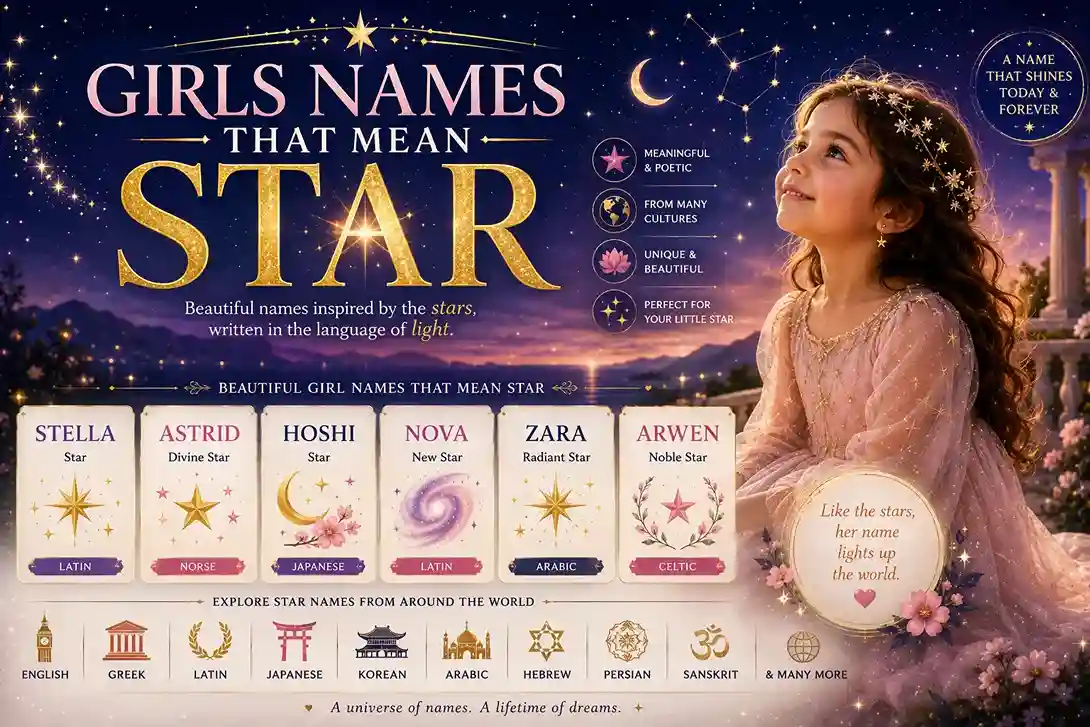
If you’re drawn to the night sky for baby name inspiration, you have more genuine options than most lists let on. Below you’ll find star names for girls that literally mean “star” in more than 20 languages, real astronomical star and constellation names, mythological star figures, and gender neutral picks. Each one is labeled clearly by origin, with plain language pronunciation help so you’re not guessing how to say a name you love.
Every entry here is grouped by how directly it connects to “star,” so you can tell at a glance which names are literal translations and which are simply star adjacent in theme. If you’re specifically looking for girl names that mean star, this distinction makes it easier to find names with the exact meaning you’re after. It’s a distinction most name lists skip entirely.
What Does It Mean for a Name to “Mean Star”?
Not every name on a “star” list actually translates to “star.” Some names, including Stella, Esther, and Seren, are direct linguistic translations of the word “star” in Latin, Persian/Hebrew, and Welsh. Others, like Aurora (“dawn”) or Luna (“moon”), are frequently grouped with star names because they share a celestial, night sky feeling, even though their literal meaning is different.
Both approaches are valid ways to choose a name. Plenty of parents want the general feeling of “starlight” rather than an exact translation. This guide simply tells you which is which, so you can decide what matters more for your family: linguistic accuracy or thematic connection.
Girl Names That Directly Mean “Star”
These names translate to “star” in their language of origin. They’re organized here as a quick reference table, followed by additional options grouped by region.
| Name | Meaning | Origin | Gender | Pronunciation | Popularity |
|---|---|---|---|---|---|
| Bituin | Star | Filipino | Female | bee-too-EEN | Uncommon |
| Suha | A faint star in Ursa Major | Arabic | Female | SOO-hah | Rare |
| Tara | Star | Sanskrit | Female | TAH-ruh | Common |
| Velesrix | Child of the stars | Arabic | Female | ve-les-rix | Rare |
| Thurayya | The Pleiades star cluster | Arabic | Female | thoo-RY-yah | Rare |
| Thalalar | Child of the stars | Italian | Female | tha-la-lar | Uncommon |
| Marie | Star of the sea | French | Female | muree | Very Common |
| Mira | A famous variable star in the constellation Cetus, meaning "wonderful" | Latin | Female | MEER-uh | Uncommon |
| Izar | Star | Basque | Female | ee-SAHR | Uncommon |
| Valanyx | Child of the stars | Italian | Female | va-la-nyx | Uncommon |
| Elenain | Child of the stars | Italian | Female | e-le-nain | Uncommon |
| Sitara | Star | Hindi | Female | sih-TAH-ruh | Uncommon |
| Sofiael | Child of the stars | English | Female | so-fiael | Uncommon |
| Yumea | Child of the stars | Japanese | Female | yu-me-a | Uncommon |
| Voileix | Child of the stars | French | Female | voi-leix | Rare |
| Lyra | The lyre (harp) constellation, home to the star Vega | Greek | Female | LY-ruh | Common |
| Aludra | "Maiden," a star in Canis Major | Arabic | Female | ah-LOO-drah | Rare |
| Citlali | Star | Nahuatl (Aztec) | Female | seet-LAH-lee | Uncommon |
| Lucero | Bright star, morning star | Spanish | Female | loo-SEH-roh | Uncommon |
| Lintang | Star (used for any gender) | Indonesian | Female | lin-TANG | Uncommon |
| Whetū | Star | Māori | Female | FEH-too | Uncommon |
| Molly | Star of the sea | English | Female | mahlee | Very Common |
| Vespera | Evening star | English | Female | vayspehruh | Uncommon |
| Etoile | Star | French | Female | ay-TWAHL | Uncommon |
| Passioneon | Child of the stars | Italian | Female | pas-sio-neon | Rare |
| Vedette | Star, leading performer | French | Female | veh-DET | Uncommon |
| Realta | Star | Irish | Female | RYAL-tuh | Uncommon |
| Mollyin | Child of the stars | English | Female | mol-lyin | Uncommon |
| Aelindra | Daughter of starlight | English | Female | ae-lin-dra | Rare |
| Kalesia | Child of the stars | Italian | Female | ka-le-sia | Uncommon |
| Tähti | Star | Finnish | Female | TAH-tee | Uncommon |
| Elalar | Child of the stars | Japanese | Female | e-la-la-r | Uncommon |
| Yildiz | Star | Turkish | Female | yil-DUZ | Uncommon |
| Aiin | Child of the stars | Japanese | Female | ai-i-n | Uncommon |
| Odtsetseg | Star flower | Mongolian | Female | ot-SET-seg | Uncommon |
| Maia | One of the seven Pleiades sisters, a star cluster in Taurus | Greek | Female | MY-uh | Common |
| Estella | Star | Latin | Female | es-TEL-uh | Uncommon |
| Lusine | Moon or star (context dependent) | Armenian | Female | loo-SEEN | Uncommon |
| Zvezda | Star | Slavic | Female | ZVEZ-dah | Uncommon |
| Aster | Star | Greek | Female | AS-ter | Uncommon |
| Falaketh | Child of the stars | Arabic | Female | fa-la-ket | Rare |
| Yukion | Child of the stars | Japanese | Female | yu-ki-o-n | Uncommon |
| Estel | Star | Spanish | Female | es-TEL | Uncommon |
| Nova | New star / new moon | Latin | Female | NOH-vah | Very Common |
| Galiniel | Child of the stars | Italian | Female | ga-li-niel | Rare |
| Danica | Morning star | Slavic | Female | DAN-ih-kuh | Uncommon |
| Yoko | Sun or ocean child; often listed among star related Japanese names | Japanese | Female | YOH-koh | Uncommon |
| Sterre | Star | Dutch | Female | STEH-ruh | Uncommon |
| Okikuia | Child of the stars | Japanese | Female | o-ki-ku-ia | Rare |
| Valanion | Child of the stars | English | Female | va-la-nion | Rare |
| Esther | Star | Persian | Female | ES-ter | Common |
| Seren | Star | Welsh | Female | SEH-ren | Uncommon |
| Helordra | Child of the stars | French | Female | he-lor-dra | Uncommon |
| Estrella | Star | Spanish | Female | es-TREY-uh | Uncommon |
| Astra | Star | Greek | Female | AS-truh | Uncommon |
| Hesper | Evening star | Greek | Female | HES-per | Uncommon |
| Delolix | Child of the stars | Arabic | Female | de-lo-lix | Uncommon |
| Halasara | Child of the stars | Italian | Female | ha-la-sa-ra | Uncommon |
| Celinara | Child of the stars | English | Female | ce-li-na-ra | Rare |
| Marisol | Sea and sun; often paired thematically with star/celestial names | Spanish | Female | mah-ree-SOL | Uncommon |
| Feninvel | Child of the stars | Japanese | Female | fe-ni-n-ve-l | Rare |
| Sidra | Like a star | Arabic | Female | SEE-druh | Uncommon |
| Stella | Star | Latin | Female | STEL-uh | Very Common |
| Hoshi | Star | Japanese | Female | HOH-shee | Uncommon |
| Dara | Star | Khmer | Female | DAH-ruh | Uncommon |
| Thalorael | Child of the stars | Italian | Female | tha-lo-rael | Rare |
| Xelara | Star weaver | English | Female | xe-la-ra | Rare |
| Sophieon | Child of the stars | English | Female | sop-hieon | Uncommon |
| Zorya | Dawn goddess associated with the morning and evening star | Slavic | Female | ZOR-yah | Rare |
| Elanor | Star sun | Sindarin (Tolkien) | Female | E-la-nor | Rare |
| Selene | Greek moon goddess, frequently grouped with star names for its celestial theme (not a literal "star" name) | Greek | Female | suh-LEE-nee | Common |
| Csilla | Star | Hungarian | Female | CHEE-luh | Uncommon |
| Celeste | Heavenly / stars | Latin | Female | seh-LEST | Very Common |
| Alcyone | "Kingfisher," the brightest star in the Pleiades cluster, Taurus | Greek | Female | al-SY-uh-nee | Rare |
| Estelle | Star | French | Female | es-TEL | Common |
| Skylarar | Child of the stars | English | Female | sky-la-rar | Uncommon |
| Joliear | Child of the stars | French | Female | jo-liear | Uncommon |
| Silviael | Child of the stars | Italian | Female | sil-viael | Uncommon |
| Zoryana | Star, dawn | Ukrainian | Female | zor-YAH-nuh | Uncommon |
| Ulloriaq | Star | Greenlandic | Female | oo-LOR-ee-ahk | Uncommon |
| Kawkab | Planet star | Arabic | Female | kaw-kab | Rare |
| Maristela | Star of the sea | Spanish | Female | mah-ree-STEH-lah | Uncommon |
| Darel | Child of the stars | English | Female | da-rel | Uncommon |
| Pleione | Mother of the Pleiades in Greek myth; a star in Taurus | Greek | Female | ply-OH-nee | Rare |
| Najma | Star | Arabic | Female | NAJ-mah | Uncommon |
| Nyx | Greek goddess of the night, mother of the stars in some myths | Greek | Female | NIKS | Uncommon |
| Itri | Star | Tamazight (Berber) | Female | IT-ree | Uncommon |
| Nashira | "Bearer of good news" or "lucky one," a star in Capricornus | Arabic | Female | nah-SHEER-uh | Rare |
| Tsukihoshi | Moon and star | Japanese | Female | — | Rare |
| Zornitsa | Morning star | Bulgarian | Female | zor-NEET-suh | Uncommon |
| Kalarix | Child of the stars | English | Female | ka-la-rix | Rare |
| Astraea | Greek goddess of innocence and justice, later placed among the stars as the constellation Virgo | Greek | Female | as-TREE-uh | Rare |
| Starla | Little star of the moon | English | Female | STAR-lah | Uncommon |
| Bellatrix | "Female warrior," the third brightest star in Orion | Latin | Female | bel-AY-triks | Uncommon |
| Asteria | Greek Titan goddess associated with falling stars and prophetic night visions | Greek | Female | as-TEER-ee-uh | Rare |
| Zareneth | Child of the stars | Arabic | Female | za-re-net | Rare |
| Astriel | Star-moon elf | Fantasy | Female | AS-tree-el | Rare |
| Hoshiko | Star child | Japanese | Female | hoh-SHEE-koh | Uncommon |
| Hoshizuki | Star moon | Japanese | Female | — | Rare |
| Ayumiar | Child of the stars | Japanese | Female | ay-u-mi-a-r | Uncommon |
Latin, Romance & Southern European Origins
- Marisol: Sea and sun; often paired thematically with star/celestial names (Spanish)
- Lucero: Bright star, morning star (Spanish)
- Maristela: Star of the sea (Spanish/Portuguese)
- Vedette: Star, leading performer (French)
- Étoile: Star (French)
Slavic & Eastern European Origins
- Zorya: Dawn goddess associated with the morning and evening star (Slavic mythology)
- Lusine: Moon or star (context dependent) (Armenian)
Arabic & Middle Eastern Origins
- Zuhra: Bright, shining; associated with the planet Venus (Arabic)
- Thurayya: The Pleiades star cluster (Arabic)
South & East Asian Origins
- Yōko: Sun or ocean child; often listed among star related Japanese names (Japanese)
- Haruko: Sun child (Japanese)
- Byeong-Ho: Bright, luminous, vast sky (Korean)
- Seong-Jin: Star or planet, combined with town (Korean)
- Odtsetseg: Star flower (Mongolian)
Indigenous & Native Names
- Wâpanacâhkos: Morning star (Venus) (Cree)
- Sons-ee-ah-ray: Morning star (Apache)
- Ahtahkakoop: Star blanket (traditionally masculine, occasionally used broadly) (Cree)
Girl Names From Real Stars and Constellations
For a name with an even more literal connection to the night sky, consider naming your daughter after an actual star or constellation. These names come from real celestial objects astronomers have catalogued and named, most rooted in Greek mythology or Arabic astronomical terminology.
| Name | What It Refers To | Origin |
| Vega | “Swooping/falling eagle,” the brightest star in the constellation Lyra | Arabic origin |
| Alcyone | “Kingfisher,” the brightest star in the Pleiades cluster, Taurus | Greek mythology |
| Maia | One of the seven Pleiades sisters, a star cluster in Taurus | Greek mythology |
| Pleione | Mother of the Pleiades in Greek myth; a star in Taurus | Greek mythology |
| Bellatrix | “Female warrior,” the third brightest star in Orion | Latin |
| Electra | A star in the Pleiades cluster meaning “shining” or “bright” | Greek |
| Aludra | “Maiden,” a star in Canis Major | Arabic |
| Arista | A star in the Virgo constellation | Latin |
| Mira | A famous variable star in the constellation Cetus, meaning “wonderful” | Latin |
| Nashira | “Bearer of good news” or “lucky one,” a star in Capricornus | Arabic |
Constellation Names for Girls
Beyond individual stars, whole constellations offer feminine leaning names with built in celestial meaning:
- Lyra: The lyre (harp) constellation, home to the star Vega
- Carina: “Keel,” a Southern Hemisphere constellation; also means “dear little one” in Italian
- Cassiopeia: A Northern Hemisphere constellation named for a mythical queen
- Andromeda: A constellation and galaxy named for a Greek princess
- Ursa: “Bear,” the root of Ursa Major and Ursa Minor
- Vela: “Sails,” a Southern Hemisphere constellation
- Virgo: “The maiden,” a constellation and zodiac sign
- Norma: A faint Southern Hemisphere constellation representing a carpenter’s square
Star Goddesses & Mythological Names for Girls
Several mythological figures are directly tied to stars, star clusters, or the night sky, giving their names a rich origin story alongside the celestial meaning:
- Astraea: Greek goddess of innocence and justice, later placed among the stars as the constellation Virgo
- Asteria: Greek Titan goddess associated with falling stars and prophetic night visions
- Selene: Greek moon goddess, frequently grouped with star names for its celestial theme (not a literal “star” name)
- Nyx: Greek goddess of the night, mother of the stars in some myths
Rare and Unique Star Names for Girls
If popularity matters to you, whether because you want something distinctive or because a name feels more special the less common it is, these options mean “star” just as literally as Stella or Esther, but are rarely seen outside their language of origin:
- Odtsetseg: Star flower (Mongolian)
- Zoryana: Star, dawn (Ukrainian)
- Ulloriaq: Star (Greenlandic)
- Itri: Star (Tamazight (Berber))
- Wâpanacâhkos: Morning star (Venus) (Cree)
- Sons-ee-ah-ray: Morning star (Apache)
- Thurayya: The Pleiades cluster (Arabic)
- Nashira: Lucky star, bearer of good news (Arabic)
Popular Star Names for Girls Right Now
If you’d rather choose a name that’s familiar and easy for others to say and spell, these star themed names are currently well established or trending in English speaking countries:
| Name | Origin | Why It’s Popular |
| Stella | Latin | Consistently ranks among the more popular star meaning names in the U.S. and UK; short, familiar, and easy to pronounce. |
| Esther | Persian/Hebrew | A long standing biblical classic with steady, moderate popularity. |
| Luna | Latin | Extremely popular. It literally means “moon,” but it’s almost always included on star and celestial themed lists because of its night sky association. |
| Nova | Latin (“new”) | A fast rising modern pick, referring to a star that suddenly brightens. |
| Estelle | French | A vintage style name that has seen renewed interest in recent years. |
Popularity naturally shifts year to year. If current rankings matter to your decision, check your country’s official statistics agency (for example, the U.S. Social Security Administration publishes an annually updated list of baby name frequency) for the most current data before you decide.
Gender Neutral Names That Mean Star
These names carry a genuine “star” or closely related celestial meaning and are commonly used for children of any gender:
| Name | Meaning | Origin |
| Dara | Star | Khmer |
| Sol | Sun (closest star to Earth) | Spanish/Portuguese/Hebrew (short for Solomon) |
| Skylar | Scholar; also “starlit” | Dutch |
| Vesper | Evening star | Latin |
| Galaxy | Star system/collection of stars | English (modern coinage) |
| Aquarius | Zodiac constellation | Latin |
| Phoenix | Mythical bird associated with a constellation | Greek |
| Ylli | Star | Albanian |
Names Often Mistaken for “Star” Names
Because most baby name lists group anything celestial together, several very popular names get labeled “means star” when they don’t, technically, mean that at all. Worth knowing before you fall in love with a meaning that isn’t quite accurate:
| Common Mix Ups to Know |
|---|
| 1. Aurora means “dawn,” not “star.” It is grouped with star names because of its sunrise and sky imagery, not because of a literal translation. 2. Luna means “moon,” not “star.” It appears on nearly every “star name” list because of its night sky association, but it is a lunar name. 3. Marisol means “sea and sun” (a blend of Maria and Sol), not “star.” It is often included on star lists simply for its sunny, celestial feel. 4. Roxana and Roxanne mean “dawn” or “bright,” not “star.” Their brightness association is what gets them grouped with star names. |
How to Choose a Star Themed Name for Your Daughter
A meaningful name is only part of the decision. A few practical questions worth working through before you commit:
- Do you want a literal translation or a thematic connection? Decide whether “means star” needs to be exact (Stella, Tara, Seren) or whether a broader celestial feeling (Luna, Aurora, Nova) works just as well for your family.
- How will it sound with your last name? Say the full name out loud, first, middle, and last, to check the rhythm and watch for awkward repeated sounds.
- Is there a natural nickname? Names like Estella (Stella, Essie), Estrella (Estre, Ella), and Bellatrix (Bella) offer a longer formal name with a shorter everyday option built in.
- How will it pair with a sibling’s name? If you already have a child’s name chosen, look for a similar style or origin. Pairing a Latin name like Stella with another Latin origin name, for instance, tends to feel more cohesive than mixing very different linguistic styles.
- If the name comes from a culture other than your own, take a moment to learn its context. Names like Sitara, Najma, or Citlali carry specific cultural and linguistic weight. Understanding their background, and, where possible, checking pronunciation with a native speaker, is a simple way to use the name respectfully.
- Can you pronounce it confidently? A name you’ll say (and spell out) thousands of times should feel comfortable in your own mouth. Practice it out loud, not just on paper.
Frequently Asked Questions
What is a girl’s name that means star?
Many names mean “star” directly across different languages, including Stella and Aster (Latin/Greek), Esther (Persian/Hebrew), Seren (Welsh), Tara (Sanskrit), Sitara (Hindi/Urdu), Hoshi (Japanese), and Najma (Arabic). Each carries the same core meaning through a different linguistic and cultural lens.
What are some rare or unique names that mean star?
For a less common option, consider Odtsetseg (Mongolian, “star flower”), Zoryana (Ukrainian, “star/dawn”), Ulloriaq (Greenlandic, “star”), Itri (Tamazight, “star”), or Thurayya (Arabic, referring to the Pleiades cluster). These names are linguistically accurate to “star” while being far less common in Western naming charts.
What name means star in Arabic, Welsh, Sanskrit, or Japanese?
In Arabic, Najma means “star.” In Welsh, it’s Seren. In Sanskrit, it’s Tara. In Japanese, Hoshi is the word for “star,” with Hoshiko (“star child”) as a related, name friendly variant.
Is Stella, Esther, or Luna a name that means star?
Stella and Esther both literally mean “star” in their respective origins (Latin and Persian/Hebrew). Luna does not; it means “moon.” Luna is commonly grouped with star names for its shared night sky theme, but if a literal “star” meaning matters to you, Stella or Esther is the more accurate choice.
What’s a good middle name to pair with a star themed first name?
Short, single meaning first names like Stella or Tara pair well with a longer, more distinctive middle name for balance (for example, Stella Marisol or Tara Wren). Conversely, a longer or less common first name like Sitara or Zoryana often works nicely with a simple one syllable middle name. As a general rule, aim for contrasting rhythm: a short first name with a longer middle name, or the reverse, so the full name flows well when spoken aloud.
Do names that mean star work well as gender neutral choices?
Yes. Dara (Khmer), Sol (Spanish/Portuguese/Hebrew), Vesper (Latin, “evening star”), and Ylli (Albanian) are all used for children of any gender and carry a genuine “star” or closely related celestial meaning, making them solid gender neutral options.
Final Thoughts
Whether you want a name that translates precisely to “star” or one that simply carries that same sense of light and wonder, there’s real range here, from the familiar (Stella, Esther, Luna) to the rare (Odtsetseg, Ulloriaq, Thurayya). The right choice usually comes down to how the name sounds to you, how it fits your family, and whether the meaning behind it, literal or thematic, feels true to the reasons you’re choosing it in the first place.
Note on sourcing: Name meanings and origins in this guide were cross checked against multiple published name etymology references. Language and pronunciation conventions can vary by region and dialect; if a specific meaning matters for a formal or cultural purpose, consider confirming with a fluent speaker or a specialist linguistic source.